
Commercial Solar UK
Commercial Solar Panels make your business more energy efficient.

TOTAL INSTALLS
800+

10+ years install experience




Engineering Profitable Solar Assets for UK Businesses
High energy costs are not just an overhead; they are a strategic risk to UK businesses. With grid electricity rates for commercial users fluctuating between 22p and 35p per kWh, generating your own power for as little as 4-5p per kWh is a direct investment in financial resilience.
We are a team of Manchester & London based engineers and technicians specialising in the design and installation of commercial solar PV systems. Our work focuses on turning your roof space or unused land into a predictable, low-cost energy source.
As participates in the TrustMark scheme we handle every technical stage, from the initial structural survey and system design to navigating the complex District Network Operator (DNO) grid connection process under G98 and G99 protocols. Our experience with over 800 installations informs every decision we make.
Types of Commercial Solar Panels
Commercial solar panels come in two main types. Each type suits different business needs and spaces.
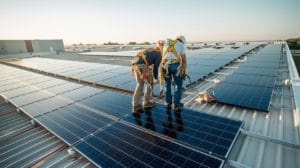
Roof
Mounted
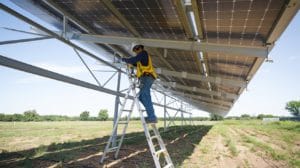
Ground Mounted
Solar Farms
Key Advantages of Commercial Solar Panels for Businesses
The UK’s energy market presents unique challenges. Wholesale price volatility remains high, and National Grid connection queues for new projects have grown substantially, with some DNOs quoting connection dates years into the future. Securing a grid connection agreement is now as critical as the hardware itself. We manage this entire process, submitting detailed applications to ensure your project secures its place without delay.
Furthermore, the upcoming 2026 business rates revaluation will see significant rises in Rateable Values for solar assets in England and Wales, a factor that must be modelled into any financial forecast.
Lowering Energy Costs
Solar panels help companies spend less on electricity. Most systems generate power for 4–5p per kWh, yet grid rates are 20–25p per kWh, which means savings rise quickly.
| Feature | Fact | Impact |
|---|---|---|
| Power cost with solar | 4–5p per kWh | Lower bills for the business |
| Power cost from grid | 20–25p per kWh | Higher outgoings without solar panels |
| Payback period | 3–5 years (before tax benefits) | Quick return, then long-term savings |
| Sell extra electricity | Firms can sell unused solar power | Additional revenue for the company |
After the payback period, all savings support company growth since firms face fewer rising costs. Smart solar systems track usage, so businesses boost their savings and improve their eco profile.
Achieving Energy Independence
Solar systems give firms more control over energy. Panels let businesses generate their own power, so they avoid high grid costs and reduce worries about outages.
Battery storage increases freedom. Companies store unused solar energy, so they can use it at night or on cloudy days.
- Solar panels: Provide daily, clean power for the business, so firms avoid grid price hikes.
- Battery storage: Keeps extra energy safe, so businesses access electricity 24/7.
This combination leads to strong savings and more stable operations over time, so companies protect their future as well as their budget.
Which Sectors Do You Work In?
Listed below are the types of businesses we supply commercial solar panels to:
Car Parks & Solar carports
We also design and install solar carports, which optimise parking areas and provide the infrastructure for EV charging stations, supporting your transition to an electric fleet ahead of the UK’s 2035 targets.
Industrial Buildings
For factories and industrial units with heavy machinery, a solar PV system directly counters high daytime energy consumption. We specify robust three phase inverters from brands like SMA or SolarEdge, designed to handle the high electrical loads of production lines. Our installation on an industrial building for Tracklements saves 65,779 kg of CO₂ annually.
Office Buildings
Modern office solar energy use is defined by consistent demand from HVAC, lighting, and IT. A solar installation hedges against price volatility.
Farms
Farms face intense energy demands from refrigeration, grain drying, and milking parlours. We transform barn roofs into generating assets. For a project with the RSPB, the system we installed cuts 129,958 kg of CO₂ per year, demonstrating how solar supports land-based organisations’ environmental goals.

System Design & Installation: Beyond the Panels
A successful commercial solar project depends on far more than the panels themselves. The engineering choices for inverters, mounting systems, and electrical infrastructure determine the system’s lifetime performance and safety.
Roof-Mounted Solar: Structural Integrity is Paramount
Most commercial solar installations are ‘permitted developments’ and do not require lengthy planning permission, provided the system doesn’t protrude more than 200mm from the roof slope. Our first step is always a full structural survey to assess the load-bearing capacity of your roof, whether it’s a modern trapezoidal metal sheet on a logistics hub or an older roof on a manufacturing plant. We use non-penetrating mounting systems where appropriate to protect roof integrity and ensure compliance with UK building regulations.
Ground-Mounted Solar & Agrivoltaics
For businesses with available land, ground-mounted arrays offer scalability. Planning permission from the local authority is required, particularly when dealing with agricultural land. We guide you through this process, focusing on the use of lower-quality agricultural land to align with National Planning Policy Framework guidance. We also have design experience in agrivoltaics, pairing solar generation with active farming like sheep grazing or creating biodiverse habitats, which can strengthen planning applications.
Building the Financial Case: Payback, Tax, and Long-Term Value
De-Risking Your Energy Spend
With a typical payback period of 3.5 to 6 years, a solar installation effectively allows you to fix a major operational cost for 25+ years. After this payback period, the electricity generated is almost entirely profit. A 250kWp system, common on a medium-sized warehouse, not only reduces costs but also abates approximately 64 tonnes of CO₂ annually, supporting your ESG reporting and net-zero targets.
Leveraging UK Capital Allowances
The UK government’s Full Expensing scheme allows companies to claim 100% of the cost of qualifying plant and machinery, including solar PV systems, as a deduction from profits in the year of purchase. This can significantly reduce your corporation tax bill, effectively lowering the net cost of the investment by up to 25p for every pound spent.
Achieving Grid Independence with Battery Storage (BESS)
Pairing your solar array with a Battery Energy Storage System (BESS) provides ultimate control. We design systems using robust commercial units from manufacturers like Tesla or Sonnen. A BESS allows you to store cheap daytime solar energy for use during peak evening and morning hours, protecting you from grid outages and the highest time-of-use tariffs. This combination ensures operational continuity, 24/7.