
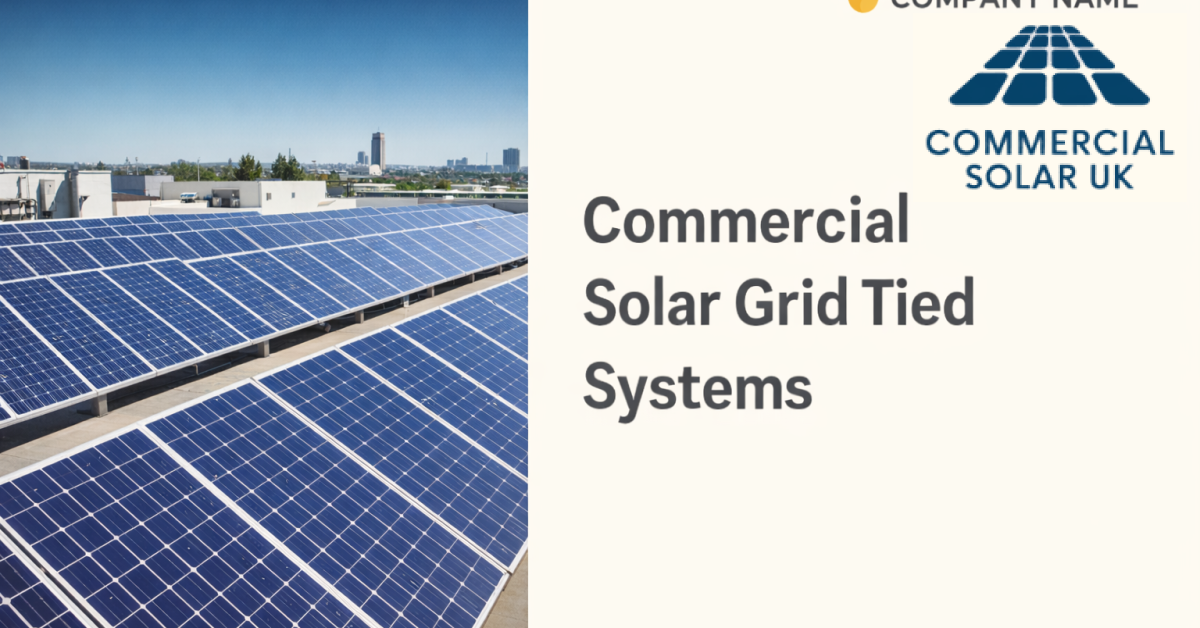
Commercial Solar Grid Tied Systems
A grid-tied solar system connects your business premises directly to the public electricity network. It generates power to cover your on-site daytime demand first, exporting any surplus back to the grid.
This is the most common model for UK commercial solar because it avoids the capital cost of battery storage, targeting the primary goal of reducing daytime energy expenditure. For a recent client with a food processing facility in Rochdale, their 350kWp rooftop system now offsets 70% of their daytime load from the local Electricity North West network.
The result is a direct impact on operating costs and verifiable data for ESG reports. Operation is simple, and the system is designed for compliance with UK export schemes like the Smart Export Guarantee (SEG).
What a Grid-Tied System Actually Is (And Isn’t)
A commercial grid-tied system is a solar PV installation that works in parallel with your DNO’s local grid infrastructure. It cannot provide power during a grid outage. For safety, anti-islanding protection in the inverter automatically shuts the system down when it detects a power cut, protecting engineers working on the lines. A system with backup power is a “hybrid” system, which requires a specific type of inverter and expensive battery storage.
The design includes solar panels, inverters, mounting systems, protection equipment, and grid connection infrastructure approved by the Distribution Network Operator (DNO).
Definition And Core Components
A commercial grid tied system is a non-battery solar PV system that operates in parallel with the public grid. Core components include solar modules, inverters, mounting structures, AC and DC cabling, generation meters, and isolation equipment.
How Grid Connection Works
The inverter synchronises output with the grid’s voltage and frequency. Electricity flows to on-site loads first. Surplus generation passes through the export meter and into the local network, subject to DNO approval.
Difference Between Grid Tied And Off-Grid Systems
Grid tied systems rely on the public network for stability and backup. Off-grid systems operate independently and require battery storage and backup generation to maintain supply.
Grid-tied is fundamentally a cost-saving measure, not a resilience one. It uses the grid as a giant, free battery, absorbing excess energy you produce and supplying power when your panels are not generating.
How Commercial Grid Tied Solar Systems Work
Commercial systems follow a simple flow: panels generate DC electricity, inverters convert it to AC, and the power feeds the building’s distribution board. Real-time generation reduces imported electricity from the supplier.
When production exceeds demand, energy exports automatically. Export payments depend on the agreed tariff and metering arrangement.
Solar Panels And DC Generation
Solar PV modules convert sunlight into direct current (DC) electricity. Output varies with irradiance, temperature, and panel orientation.
Inverters And AC Conversion
Inverters convert DC electricity into grid-compatible alternating current (AC). Commercial sites typically use string or central inverters depending on system size.
Grid Synchronisation And Export
Grid tied inverters match grid frequency and voltage before exporting power. Anti-islanding protection disconnects the system during grid faults.
Net Metering And Export Tariffs
The UK uses the Smart Export Guarantee rather than traditional net metering. Energy suppliers pay for exported electricity at agreed rates, measured by a compliant export meter.
How It Works on a UK Commercial Property: A Project Example
Consider a 150kWp system we installed on a warehouse in the Trafford Park industrial estate, Manchester.
- Generation: 345 Trina Vertex N 725W panels convert sunlight into DC electricity. Their output fluctuates based on the notoriously variable North West cloud cover.
- Conversion: The DC power runs to a bank of SMA Tripower X string inverters, which convert it into 400V three-phase AC power, synchronised with the grid’s frequency and voltage.
- Consumption & Export: This AC power feeds the building’s main distribution board, powering lighting, machinery, and office equipment. When the panels generate more power than the site is using, the surplus flows through an export meter and is sold to the grid under a pre-agreed SEG tariff, typically around 15p/kWh with a supplier like British Gas. The entire process is managed automatically by the inverter’s grid-synchronisation controls.
Key Components Of A Commercial Grid Tied System
Each component affects performance, safety, and long-term reliability. System design reflects roof type, available space, electrical capacity, and projected energy demand.
Quality equipment and correct installation reduce downtime and ensure compliance with UK standards.
Solar PV Modules
Most UK commercial projects now use high-efficiency N-type monocrystalline panels like the Jinko Tiger Neo or LONGi Hi-MO 7 to maximise generation from limited roof space. For a project on a food-grade facility with strict low-carbon supply chain requirements, we might specify First Solar’s thin-film panels due to their low embodied carbon.
String And Central Inverters
String inverters manage smaller groups of panels. Central inverters handle larger arrays with higher capacity. Selection depends on layout, shading conditions, and maintenance strategy.
Mounting Structures
On a typical trapezoidal metal roof found on many UK warehouses, a non-penetrative clamp system is used. For a flat membrane roof, a ballasted system is calculated to withstand wind loading without compromising the roof’s integrity.
Monitoring And Performance Tracking
Monitoring systems provide real-time generation data through web portals or on-site displays. Performance tracking supports fault detection and ESG reporting.
Protection And Isolation Equipment
This includes the mandatory DC and AC isolators, circuit breakers, and surge protection devices required under the UK’s Electricity at Work Regulations. This equipment is essential for protecting both the solar asset and your building’s electrical infrastructure.
Benefits Of Commercial Grid Tied Solar
Grid tied solar offers financial and environmental advantages without the complexity of battery storage. Most commercial projects focus on reducing daytime electricity costs and improving sustainability credentials.
The benefits relate directly to operating cost control and carbon reporting obligations.
Reduced Electricity Bills
On-site solar generation reduces imported electricity during daylight hours. Businesses with consistent daytime demand gain the strongest savings.
Lower Capital Cost Compared To Battery Systems
Grid tied systems exclude battery storage, which lowers upfront expenditure. Simpler design reduces installation complexity and payback time.
Improved Sustainability And ESG Reporting
Solar generation lowers Scope 2 emissions linked to purchased electricity. Generation data supports carbon reduction reporting and investor disclosures.
Scalability For Growing Energy Demand
Systems expand in phases if roof space and grid capacity allow. Additional panels integrate with existing infrastructure.
The Business Case: Real-World Financial Outcomes
Grid-tied solar directly attacks your Scope 2 emissions by reducing purchased electricity.
- Reduced Electricity Bills: The primary saving comes from avoiding grid imports. A manufacturing client in Tyseley, Birmingham, with heavy daytime machinery use, slashed their daytime energy spend by 65% after we installed a 200kWp system.
- Lower Upfront Cost: Excluding batteries significantly lowers capital expenditure. A typical 100kWp grid-tied system costs far less than a comparable hybrid setup, shortening the payback period.
- Auditable ESG Data: Monitoring portals provide granular generation data that can be fed directly into annual sustainability and ESG reports to satisfy investor and supply chain requirements.
The Hurdles: DNO Approvals, Structural Risks & Planning Rules
Feasibility is determined by technical and administrative checks. Ignoring these leads to costly delays.
- No Power During Grid Outages: This is the system’s biggest limitation. If you run a data centre or critical process facility, a grid-tied system alone is insufficient. You need a hybrid solution.
- Grid Connection Approval (G99): Any system over 16A per phase requires a formal G99 application to the local DNO, such as UK Power Networks in London or National Grid in the Midlands. This process can take 8-12 weeks and may require network reinforcement studies, which can add significant cost and time if the local substation is constrained.
- Structural & Roof Condition Checks: Many older UK warehouse roofs were not designed for the additional load of solar panels. A structural engineer must verify the load-bearing capacity before any work begins. For a recent project on a 1980s-era building in Slough Trading Estate, this meant strengthening roof purlins before the installation could proceed.
Limitations And Considerations
Grid tied systems depend on grid availability and regulatory approval. Technical, structural, and administrative checks influence feasibility.
Early assessment avoids delays and unexpected reinforcement costs.
No Power During Grid Outages
Standard grid tied systems shut down during power cuts for safety. Backup supply requires a hybrid inverter and battery storage.
Grid Connection Approval Requirements
The local DNO assesses export capacity and may limit system size. Larger installations require formal application and approval before installation.
Roof Suitability And Structural Checks
Structural engineers assess load-bearing capacity. Roof orientation, shading, and membrane condition affect system viability.
Planning Permission And DNO Requirements
Most rooftop commercial systems fall under permitted development, subject to conditions. Listed buildings and conservation areas require formal planning approval.
Grid Tied Vs Hybrid Vs Off-Grid Systems
System choice affects cost, resilience, and operational flexibility. Grid tied systems prioritise savings, hybrid systems add storage, and off-grid systems operate independently of public supply.
| System Type | Grid Connection | Battery Storage | Backup During Outage | Typical Use Case | Relative Cost |
|---|---|---|---|---|---|
| Grid Tied | Yes | No | No | Offices, warehouses, retail | Low |
| Hybrid | Yes | Yes | Yes (limited) | Sites needing resilience | Medium |
| Off-Grid | No | Yes (essential) | Yes | Remote locations | High |
Grid tied systems suit most UK commercial properties with stable grid access and daytime energy use. If you’re comparing options beyond grid-tied, see our guide to common commercial solar system types for a broader overview of how these configurations differ.
Costs And Return On Investment
Costs depend on system size, roof type, grid connection works, and equipment specification. Commercial installations are priced per kilowatt-peak (kWp), with costs decreasing as system size increases.
Return on investment reflects electricity price, export rate, system performance, and funding structure.
Upfront Installation Costs
A 100kWp system might range from £85,000 to £105,000, depending on the hardware specified and the complexity of the roof and electrical integration.
Operational Savings
Savings arise from reduced imported electricity and export payments. Higher on-site consumption improves financial performance.
Payback Period Factors
This is influenced heavily by your site’s electricity consumption profile and future energy price inflation. For a distribution centre in Daventry with high 24/7 baseload but lower daytime peaks, the payback was around 6 years. In contrast, a manufacturing plant with a 9-5 operation saw a payback under 4 years.
Maintenance And Ongoing Costs
Maintenance is minimal. It typically involves an annual inspection and periodic inverter servicing to comply with warranty conditions.
UK Regulations And Compliance
UK commercial solar installations must meet electrical, safety, and grid connection standards. Regulatory compliance protects both the building and the wider network.
Installers typically manage approval processes and certification.
Distribution Network Operator Approval
We handle the G99 engineering recommendations and application submission to the relevant DNO, be it SP Energy Networks in Scotland or Northern Powergrid in the North East.
MCS And Installation Standards
While MCS certification is often associated with domestic installs, adherence to these standards is a benchmark of quality and often required for insurance and financing.
Smart Export Guarantee (SEG)
SEG requires licensed suppliers to offer an export tariff. Rates are variable; Octopus Energy might offer a competitive rate, while others are significantly lower. We advise clients to shop their SEG tariff separately from their import supplier.
Health And Safety Requirements
Installations must comply with the Electricity at Work Regulations and Construction Design and Management Regulations. Risk assessments and method statements are mandatory.
Is A Grid Tied System Right For Your Business?
Suitability depends on energy profile, building condition, and strategic objectives. Businesses with high daytime electricity demand often achieve the strongest returns.
A structured assessment clarifies technical and financial viability before capital commitment.
Energy Usage Profile Assessment
We analyse your half-hourly consumption data to determine how much of a proposed system’s generation would be consumed on-site versus exported. High self-consumption delivers the best financial returns.
Site Suitability Factors
We survey your roof’s size, orientation, and condition, along with the existing electrical infrastructure. Many industrial estates like Park Royal in London have a mix of old and new buildings, each with unique challenges.
Business Objectives And Carbon Targets
The investment must align with your long-term objectives, whether that’s operational cost control, meeting decarbonisation targets, or satisfying supply chain mandates.
FAQs
What Happens To Excess Electricity In A Grid Tied System?
Excess electricity exports automatically to the grid through an approved meter. The energy supplier pays for exported units under the agreed SEG tariff.
Do Commercial Grid Tied Systems Work During A Power Cut?
Standard systems shut down during outages due to anti-islanding protection. Backup requires a hybrid system with battery storage.
How Long Does Installation Take?
Most rooftop commercial installations take several days to a few weeks, depending on size and grid approval timelines.
Do I Need Planning Permission For Commercial Solar?
Many rooftop systems qualify as permitted development. Exceptions apply to listed buildings, conservation areas, and ground-mounted arrays.
Conclusion
Commercial solar grid tied systems provide a cost-effective route to on-site renewable energy without the expense of battery storage. The model suits most UK businesses with stable grid access and daytime electricity demand.
Careful assessment of energy use, roof suitability, and regulatory requirements ensures reliable performance and predictable returns. For many commercial properties, grid tied solar delivers measurable savings and long-term carbon reduction.