
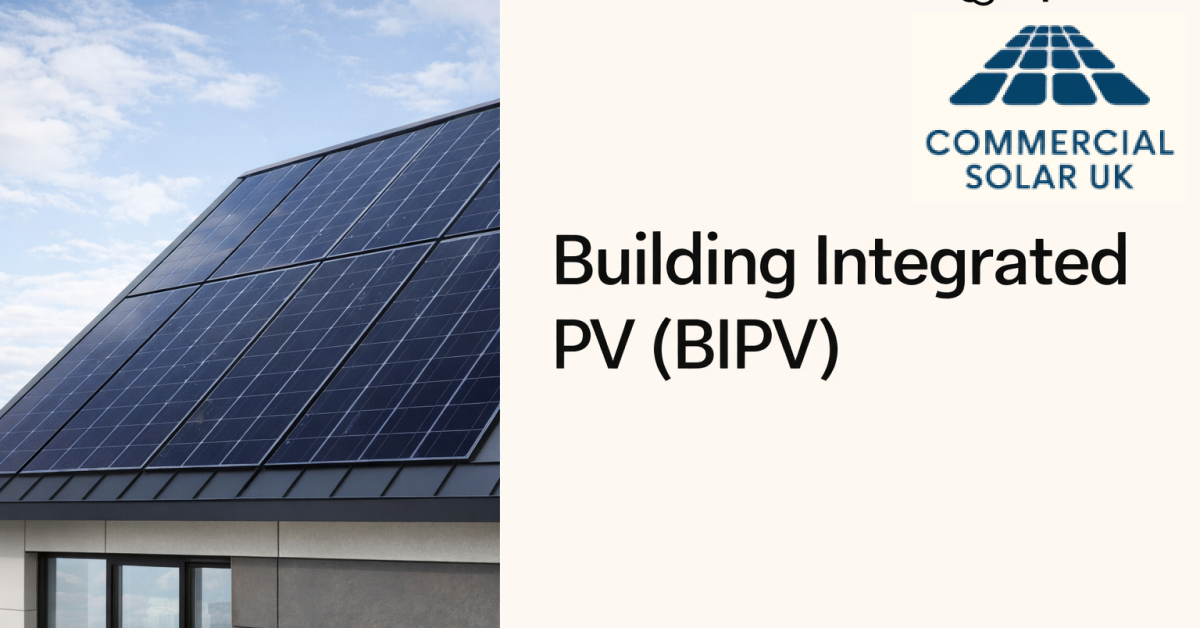
Building Integrated PV (BIPV)
Building Integrated PV is more than a renewable technology; it’s a fundamental shift in how a building’s envelope is specified. Instead of adding solar panels to a structure, the structure itself becomes the solar array.
For UK developers, this means treating your roof or façade materials as an active, energy-generating asset. We’ve moved past simple roof-mounted arrays to integrating power generation directly into the building fabric, a process that demands early coordination between architects, engineers, and specialist installers like us.
The process redefines everything from the bill of materials to the long-term ESG performance of the asset.
What Building Integrated PV (BIPV) Means
Building Integrated PV describes photovoltaic materials that serve as both building fabric and power source. BIPV systems replace elements such as roof coverings, façade panels, or glazing units, removing the need for separate mounting systems.
Traditional solar involves bolting panels onto a finished roof. BIPV is fundamentally different. The PV element is the weatherproofing layer. This has massive implications for the build program. The roofing or cladding contractor must be competent in both envelope detailing and electrical work.
Unlike add-on solar, BIPV is designed into the structure at concept stage. Architects, structural engineers, and M&E consultants coordinate early to align energy output with envelope performance.
On a recent mixed-use project in Manchester, we integrated a BIPV façade. This meant the system had to meet the same structural load and weatherproofing standards as the adjacent rainscreen panels. We worked directly with the structural engineer to ensure the fixing system could handle wind loads while allowing for thermal expansion, a detail often overlooked. This level of integration is impossible if PV is treated as a late-stage addition.
How BIPV Differs From Traditional Solar Panels
Traditional solar panels sit on brackets above existing roof finishes. BIPV products replace tiles, cladding panels, or glazing units and perform the same weatherproofing role.
BIPV therefore affects structural loads, thermal performance, and detailing at junctions. On-roof systems largely operate independently of the building envelope.
Core Technologies Used In BIPV Systems
BIPV systems use crystalline silicon or thin-film photovoltaic cells. Modules are laminated into glass, metal composites, or roofing materials.
Manufacturers adapt cell spacing, transparency, and colour to suit architectural requirements. Some systems use frameless glass-glass modules for façades, while others integrate into metal standing seam roofs.
Types Of BIPV Applications
BIPV applications vary by building element. Commercial projects often combine multiple types to balance generation, daylight, and design intent.
The application dictates the technology. A large, unobstructed warehouse roof in the Midlands has a different risk profile and generation potential than a vertical façade in central London.
Selection depends on orientation, structural capacity, and visual objectives.
BIPV Roof Systems
BIPV roof systems replace traditional tiles, slates, or metal sheets. Products include solar roof tiles and integrated metal roofing with bonded PV laminates.
These are the most efficient BIPV application in the UK due to better orientation towards the sun. For a distribution centre near Milton Keynes, we installed a 500 kWp integrated system that not only generates power but also offset the cost of the conventional standing seam roof it replaced.
Roof-based BIPV generally achieves the highest output due to optimal tilt and reduced shading.
BIPV Facades
BIPV façade systems integrate PV modules into curtain walling or rainscreen cladding. Panels may be opaque or semi-transparent.
Vertical installations generate less per square metre, but they open up huge surface areas on high-rise buildings where roof space is scarce. Research from the University of York highlights that vertical bifacial panels can outperform traditional tilted panels during early mornings and late afternoons, aligning well with commercial energy usage profiles. This makes them a viable choice for urban developments from Glasgow to Brighton.
Façade generation supports high-rise offices and mixed-use developments where roof space is limited.
BIPV Glazing And Solar Windows
BIPV glazing incorporates photovoltaic cells within insulated glass units. Cell spacing allows controlled light transmission.
Solar glazing suits atriums, skylights, and south-facing curtain walls, balancing daylight with energy production.
BIPV Canopies And Shading Structures
BIPV canopies form part of entrance structures, walkways, or car parks. Modules provide weather protection while generating power.
Solar shading devices reduce cooling loads and contribute to on-site generation.
We’ve designed walkway canopies and skylights that provide shelter and generate power simultaneously. For a university campus project, we used BIPV glazing in a new atrium to help reduce cooling loads by providing shade while contributing to the building’s energy needs.
How BIPV Systems Work
BIPV systems generate direct current electricity when exposed to light. The system connects to inverters and distribution boards in the same way as conventional PV.
Performance depends on orientation, shading, and system design. Early-stage coordination ensures envelope performance and electrical output align.
Integration With The Building Envelope
BIPV modules form part of the waterproof and wind-resistant layer. Designers detail junctions, flashings, and drainage to maintain envelope integrity.
Thermal bridging and condensation risk require assessment during design. Manufacturers provide tested systems to meet façade and roofing standards.
Electrical Integration And Inverters
BIPV arrays connect in strings to inverters that convert DC to AC power. The inverter links to the building’s main distribution board.
Systems may include optimisers or microinverters where façades have varied orientations. Monitoring software tracks output and fault conditions.
Performance Factors And Orientation
South-facing roof pitches generally deliver higher yields in the UK. Vertical façades produce less per square metre but expand available surface area.
Shading from adjacent buildings and plant reduces output. Early modelling using solar analysis software supports accurate yield forecasts.
BIPV Vs On Roof Solar
BIPV and on roof solar differ in function, cost structure, and design impact. Commercial decision-makers assess both options against planning constraints, aesthetics, and capital budgets.
The choice affects build sequencing, structural design, and long-term maintenance access.
| Criteria | Building Integrated PV (BIPV) | On-Roof Solar PV | Commercial Considerations |
|---|---|---|---|
| Installation Method | Replaces building materials | Mounted above finished roof | Impacts programme and trade coordination |
| Aesthetic Impact | Integrated into façade or roof | Visibly mounted panels | Relevant for flagship or urban sites |
| Upfront Cost | Higher per m² | Lower per kWp | Balance against material offset |
| Maintenance Access | May require façade access systems | Typically roof-level access | Access strategy affects lifecycle cost |
| Retrofit Suitability | Complex on existing buildings | Straightforward on most roofs | Retrofit often favours on-roof PV |
Both systems generate renewable electricity, but common commercial solar system types vary in how they integrate with the building envelope, which affects design coordination and maintenance access.
Design And Planning Considerations
BIPV installations are subject to intense scrutiny under UK Building Regulations. Fire safety is paramount. Any façade or roofing system must comply with Approved Document B, which governs fire resistance and the use of cavity barriers. We engage fire engineers early to ensure our BIPV specifications meet these stringent requirements, avoiding costly redesigns.
Planning authorities may scrutinise façade appearance in conservation areas or city centres.
Structural And Weatherproofing Requirements
BIPV modules carry wind loads and self-weight similar to conventional cladding. Structural engineers verify fixings and support systems.
Weatherproofing details must maintain continuous barriers. Tested systems simplify warranty and insurance approval.
Fire Safety And Compliance
BIPV installations must meet fire classification requirements for roofs and façades. Reaction-to-fire ratings and cavity barrier detailing follow Approved Document B.
Cable routing and inverter locations require coordination with the fire strategy.
Planning Permission And Building Regulations In The UK
Planning permission is another hurdle. While many standard roof systems fall under permitted development, BIPV often requires a full planning application, especially for façades or properties in one of the UK’s 10,000 conservation areas.
A local authority in a historic city like Bath or York will rightly demand that a new BIPV façade preserves or enhances the area’s character. We prepare detailed visual impact assessments to support these applications. All our systems are designed and installed to meet Microgeneration Certification Scheme (MCS) standards, a prerequisite for accessing financial incentives like the Smart Export Guarantee (SEG).
Building Regulations address structural safety, electrical compliance, and energy performance.
Costs And Financial Considerations
BIPV costs differ from standard PV because the system replaces conventional materials. Developers assess capital expenditure alongside material savings and operational energy benefits.
Lifecycle analysis supports decisions on return on investment and ESG reporting.
| Cost Factor | What Is Included | Typical Cost Impact | Notes For Commercial Projects |
|---|---|---|---|
| PV Modules | Integrated glass or roofing units | Higher than standard panels | Offsets cost of cladding or tiles |
| Installation | Specialist façade or roofing labour | Moderate to high | Requires coordinated sequencing |
| Inverters And Electrical | Inverters, cabling, monitoring | Similar to on-roof PV | Depends on system size |
| Design And Engineering | Modelling, detailing, certification | Higher at early stage | Reduces risk of later redesign |
| Maintenance | Access systems and inspections | Variable | Influenced by façade access strategy |
Higher upfront costs often balance against avoided material spend and improved building performance metrics.
When we model costs for clients, we calculate the net additional cost. For example, a BIPV façade may cost £350/m², while the specified architectural cladding was already budgeted at £200/m². The true solar investment is only the £150/m² difference. When factored into a 25-year lifecycle analysis with projected energy savings and ESG benefits, BIPV frequently proves to be the superior long-term investment.
Benefits Of BIPV For Commercial Buildings
BIPV combines energy generation with functional building elements. Commercial schemes use BIPV to meet carbon targets without sacrificing lettable space.
Integration supports environmental certification and corporate sustainability objectives.
Energy Generation And On-Site Consumption
BIPV supplies electricity directly to the building’s distribution system. On-site consumption reduces grid import and exposure to price volatility.
Large roof or façade areas enable meaningful contribution to operational energy demand.
Aesthetic Integration And Brand Value
Architectural integration supports consistent façade design. Coloured or patterned modules align with brand identity in retail and headquarters projects.
Developers use BIPV to signal environmental commitment.
Space Optimisation In Urban Sites
Urban developments often have limited roof area due to plant and terraces. Façade-integrated PV expands generation capacity without requiring additional land.
Canopies over car parks create dual-use infrastructure.
Long-Term Asset Value And ESG Performance
BIPV contributes to EPC ratings and corporate ESG metrics. Improved operational performance supports asset valuation and investor requirements.
Integrated systems demonstrate forward-looking design in competitive commercial markets.
The Reality of BIPV: Limitations and Lessons Learned
BIPV projects introduce complexity. Maintenance is a significant consideration. Replacing a damaged BIPV façade panel is more involved than swapping out a standard rooftop panel and may require specialist access equipment. A clear maintenance strategy, agreed upon during the design phase, is essential to de-risk the asset for building owners.
Performance can also be a trade-off. Architectural requirements may force non-optimal orientations, and poor ventilation behind integrated panels can lead to higher temperatures and reduced efficiency. Our yield forecasts use sophisticated software to model these real-world factors, providing an honest assessment of expected energy production, not an idealized one.
Upfront Costs And Design Complexity
BIPV products cost more per square metre than conventional cladding. Design teams invest additional time in modelling and detailing.
Budget constraints may favour simpler on-roof systems.
Maintenance And Access
Façade-mounted systems may require specialist access equipment. Replacement of damaged modules can involve partial façade removal.
Clear maintenance strategies reduce operational risk.
Performance Trade-Offs Compared To Standard PV
Vertical installations generate less energy per square metre than optimally tilted panels. Architectural constraints sometimes limit orientation.
Energy modelling clarifies expected yield before commitment.
BIPV Suitability Assessment For Commercial Projects
BIPV suits projects where architecture and sustainability targets align. Early feasibility studies assess structural capacity, budget, and planning constraints.
Developers compare BIPV against on-roof PV using energy modelling and cost analysis.
New Build Vs Retrofit Projects
New builds accommodate BIPV more easily because the envelope design evolves around the system. Retrofit projects face structural and detailing constraints.
Existing façades rarely justify full replacement solely for PV integration.
Sector-Specific Use Cases
Office headquarters, education campuses, and transport hubs often adopt BIPV. Retail and mixed-use schemes use façade systems for visual impact.
Industrial warehouses typically favour large on-roof arrays.
Key Feasibility Questions For Developers
Developers assess surface area, orientation, structural capacity, and planning risk. Capital budget and ESG targets influence the decision.
Integrated design workshops identify constraints before procurement.
Is BIPV Right for Your Development?
BIPV is best suited for new-build projects where the system can be designed-in from the concept stage. It is a powerful tool for developers targeting high BREEAM ratings or seeking to make a strong statement about their commitment to sustainability.
The key questions we help our clients answer are:
- What is the primary goal: maximum generation, aesthetic integration, or brand value?
- Do the project budget and timeline allow for the required early-stage design coordination?
- Is the design team prepared to treat the building envelope as a dynamic, power-generating system?
If the answer to these questions is yes, BIPV offers a way to create architecturally significant, high-performance assets that are truly fit for the UK’s net-zero future.