
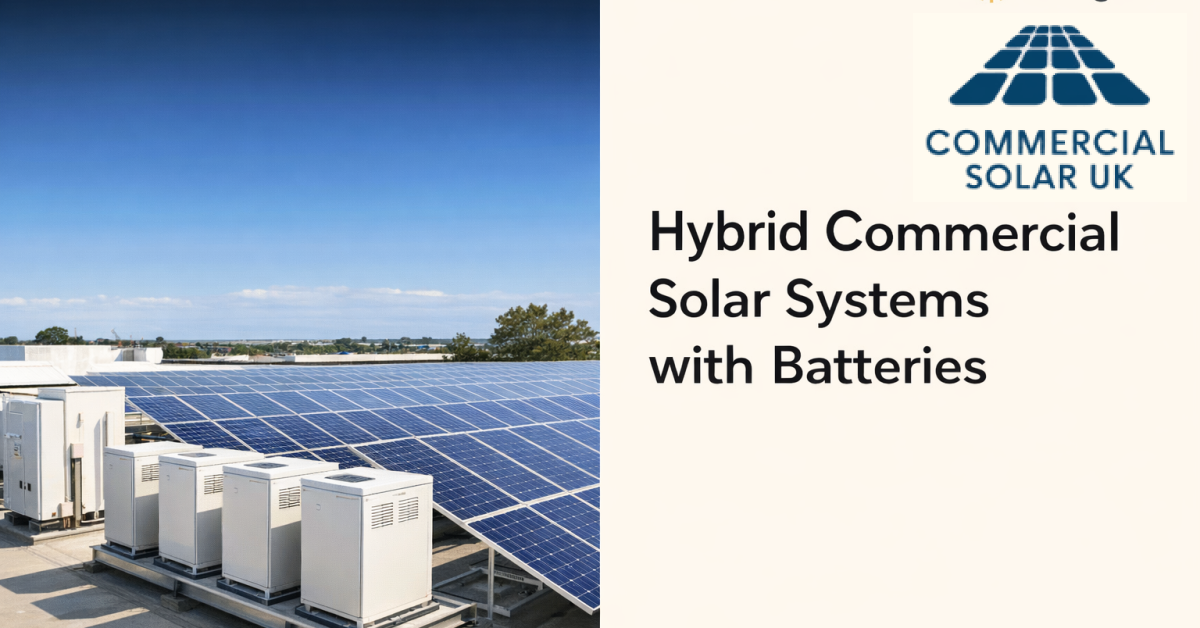
Hybrid Commercial Solar Systems with Batteries
Hybrid commercial solar systems, which integrate solar generation with on-site battery storage and a grid connection, offer UK businesses a powerful tool against volatile energy markets. They allow you to generate and use your own power in real-time, store surplus energy to avoid peak tariffs, and maintain a grid connection for absolute reliability.
For many UK businesses, particularly those facing punitive demand charges or located in areas with grid constraints, a hybrid system is the most effective strategy for managing energy costs and improving operational resilience.
What Is A Hybrid Commercial Solar System?
A commercial hybrid solar system uses a smart hybrid inverter to actively manage power from solar panels, a battery bank, and the grid. Unlike a simple grid-tied system that just exports surplus power, a hybrid installation intelligently decides where to send every kilowatt produced. This active energy management is the key difference; the system balances on-site generation, stored energy, and grid imports to optimize for cost savings and backup power, not just generation.
For example, a standard grid-tied system merely sends excess solar to the grid for a modest Smart Export Guarantee (SEG) payment. A hybrid system, by contrast, will store that same excess energy to be discharged during the 4-7 pm peak tariff window, saving significantly more on import costs than the SEG would have earned.
Off grid systems provide total independence but require massive, expensive battery banks and are impractical for most businesses connected to networks run by operators like Scottish and Southern Electricity Networks (SSEN) or UK Power Networks. A hybrid system offers a practical balance of resilience and cost.
Unlike simple grid-tied systems, hybrid systems manage energy flows actively. The design balances cost savings, backup capability and operational flexibility.
Core Components Of A Hybrid System
A hybrid system includes solar PV panels, a hybrid inverter, a battery storage system and an energy management system. Each component works together to optimise generation, storage and consumption across the site.
How Hybrid Differs From Standard Grid Tied Solar
Standard grid tied solar systems export surplus electricity directly to the grid and do not store energy on site. Hybrid systems add batteries, enabling businesses to use stored power during peak tariff periods or outages.
How Hybrid Differs From Off Grid Solar
Off grid systems operate without any grid connection and require large battery capacity for full autonomy. Hybrid systems remain connected to the grid, reducing battery size requirements and improving reliability.
How Hybrid Solar With Batteries Works In Commercial Buildings
Hybrid systems prioritise on-site solar use, store excess generation in batteries, and draw from or export to the grid depending on demand and tariff structure. An energy management system controls these flows automatically.
A well designed hybrid system, controlled by its Energy Management System (EMS), automates energy flow based on your site’s specific load profile and electricity tariff structure.
The system responds to building load, time-of-use tariffs and grid conditions. This dynamic operation supports both cost savings and resilience.
Solar Generation During Business Hours
Solar PV panels generate electricity during daylight hours. The system supplies this energy directly to building loads before charging batteries or exporting excess power.
During daylight, the system powers your on-site loads directly from the solar array. This is the most efficient use of generated power. For a recent manufacturing client in the Midlands, this direct self-consumption displaced 70% of their daytime grid demand.
Battery Charging And Discharging Cycles
Battery storage charges when solar generation exceeds demand or when grid electricity is cheaper. The system discharges stored energy during peak tariff periods or high demand, reducing import costs.
Once on-site demand is met, the surplus solar energy charges the battery bank. The EMS can also be programmed to charge the batteries with cheap off-peak grid electricity overnight. The system then automatically discharges this stored energy to “shave the peak” when your tariff rates are highest, directly reducing high Distribution Use of System (DUoS) charges that often appear on commercial bills.
Grid Interaction And Export
Hybrid systems remain connected to the grid for supplementary supply and export. Exported electricity may qualify for revenue through schemes such as the Smart Export Guarantee, subject to supplier terms.
The grid remains as a fallback. If your batteries are depleted and there is no solar, the system imports power. If your batteries are full and on-site demand is low, you can still export to the grid and earn revenue via a Smart Export Guarantee (SEG) tariff, though the rates are often more attractive for supplier’s own customers.
Backup Power And Automatic Switching
Hybrid inverters provide automatic switching during grid outages where backup functionality is enabled. Critical loads remain powered from batteries and, where available, ongoing solar generation.
When equipped with the correct inverter, the system provides near-instant backup power. In the event of an outage reported by your Distribution Network Operator (DNO) like SP Energy Networks or Northern Powergrid, the system automatically isolates from the grid and powers your designated critical loads from the battery and available solar.
For a food processing plant in Kent, this functionality prevented thousands in spoilage during a recent local outage.
Key Components Of Hybrid Commercial Solar Systems
Hybrid systems rely on integrated hardware and software to manage generation and storage efficiently. Each component influences performance, scalability and long-term value.
System specification depends on site load profile, roof space, and commercial objectives. The performance of a hybrid system is determined by its core components. We specify hardware from Tier 1 manufacturers to ensure reliability and warranty support.
Solar PV Panels
Solar PV panels convert sunlight into electricity. Commercial installations typically use high-efficiency monocrystalline modules to maximise output per square metre. We typically utilise high-efficiency monocrystalline panels to maximise energy yield, which is critical for the UK’s often overcast conditions.
Hybrid Inverter
Hybrid inverters convert DC electricity from panels and batteries into usable AC power. They manage charging, discharging and grid interaction in one unit. This is the brain of the system. We frequently specify three-phase hybrid inverters from brands like Sunsynk, Solis, or Fronius for their robust performance and advanced grid-management features. They manage DC-to-AC conversion for panels and batteries in a single unit.
Battery Storage System
Battery storage systems store surplus electricity for later use. Commercial systems often use lithium-ion technology due to higher energy density and cycle life. Most of our commercial projects use Lithium Iron Phosphate (LFP) batteries from manufacturers like GivEnergy or Pylontech due to their long cycle life and superior thermal safety profile compared to other lithium-ion chemistries.
Energy Management System (EMS)
An energy management system monitors generation, storage and consumption. The EMS is the software, often built into the inverter, that executes the charging and discharging strategy based on complex inputs like weather forecasts and fluctuating time-of-use tariffs.
Monitoring And Control Software
Monitoring software provides real-time data on performance and energy flows. Businesses use this data for reporting, optimisation and fault detection.
Benefits Of Hybrid Commercial Solar Systems
Hybrid systems provide financial, operational and environmental advantages. The combination of generation and storage improves control over energy use.
Businesses benefit from reduced exposure to volatile electricity prices and improved resilience. Hybrid systems deliver a multi-faceted ROI by attacking different parts of your electricity bill and reducing operational risk.
Lower Electricity Bills And Peak Shaving
Battery storage reduces peak-time imports by discharging during high tariff periods. This process lowers demand charges and smooths load profiles. By storing solar or cheap off-peak energy and discharging it during peak demand periods, you can flatten your load profile and slash peak demand charges, which can account for a substantial portion of a commercial energy bill.
Protection Against Power Cuts
Hybrid systems with backup capability maintain supply to essential equipment during outages. This reduces operational disruption and potential revenue loss. For businesses where even a brief power outage causes significant disruption, like data centres or automated manufacturing lines, a hybrid system provides invaluable operational continuity.
Greater Energy Independence
On-site generation and storage insulate your business from the volatility of the wholesale energy market and rising non-commodity costs like the Balancing Services Use of System (BSUoS) charge.
Improved Carbon Reporting And ESG Performance
Hybrid systems lower grid electricity consumption, reducing Scope 2 emissions. Performance data supports ESG reporting and sustainability targets.
Hybrid Vs Grid Tied Vs Off Grid Systems
Hybrid, grid-tied and off-grid systems differ in grid dependence, storage and cost. Selection depends on resilience needs, site location and budget.
| System Type | Grid Connection | Battery Storage | Backup Capability | Typical Use Case | Cost Level |
|---|---|---|---|---|---|
| Grid-Tied | Yes | No | No | Cost reduction only | ££ |
| Hybrid | Yes | Yes | Yes (limited/critical loads) | Cost + resilience | £££ |
| Off-Grid | No | Yes (large) | Yes (full site) | Remote sites | ££££ |
Hybrid systems balance cost and resilience without the high expense of full off-grid infrastructure.
Battery Options For Commercial Hybrid Systems
Battery selection affects lifespan, space requirements and total system cost. Lithium-ion dominates commercial projects, though alternatives exist for specific use cases.
While Lithium Iron Phosphate (LFP) is the dominant choice for UK commercial applications, other technologies have niche uses. LFP offers the best balance of safety, a 5,000-10,000 cycle life, and a compact footprint, making it ideal for most warehouse, factory, or office installations.
| Battery Type | Typical Capacity Range | Cycle Life | Space Requirements | Maintenance Level | Suitability For Commercial Use |
|---|---|---|---|---|---|
| Lithium-Ion | 30 kWh–5 MWh+ | 4,000–8,000 cycles | Compact | Low | High |
| Lithium Iron Phosphate (LFP) | 30 kWh–5 MWh+ | 5,000–10,000 cycles | Compact | Low | Very High |
| Lead-Acid | 10 kWh–500 kWh | 500–1,500 cycles | Larger footprint | Medium | Limited |
| Flow Battery | 100 kWh–multi MWh | 10,000+ cycles | Large | Low | Niche large-scale |
LFP batteries are common in commercial settings due to safety profile and long cycle life.
Sizing A Hybrid Commercial Solar System
Accurate sizing ensures financial and operational performance. Oversized systems increase capital cost, while undersized systems limit savings and resilience.
Designers analyse historical consumption data and future growth plans before final specification. Correct system sizing is crucial; an undersized system won’t deliver the expected savings, while an oversized one inflates capital cost and extends the payback period.
Our process begins with a detailed analysis of your half-hourly consumption data to map your unique energy load profile. This data reveals your peak demand times, your baseline energy usage, and your potential for solar self-consumption.
From there, we model battery capacity to cover your desired backup duration and to effectively mitigate the costliest peak demand charges.
Assessing Energy Demand And Load Profiles
Load profile analysis identifies daily and seasonal consumption patterns. Half-hourly data helps determine peak demand and solar self-consumption potential.
Determining Battery Capacity Requirements
Battery capacity aligns with peak demand periods and desired backup duration. Designers balance storage size against budget and expected savings.
Planning For Peak Demand And Demand Charges
Demand charges often depend on maximum half-hourly import. Battery discharge during peak intervals reduces these charges.
Future Expansion And Scalability
Modular battery systems and inverter capacity allow phased expansion. Planning for future load growth avoids costly retrofits.
Costs And Return On Investment
The higher upfront investment for a hybrid system compared to a grid-tied system is due to the cost of the batteries and more complex inverter. However, the improved savings from peak shaving and increased self-consumption often lead to a stronger overall business case.
Financial performance depends on energy prices, demand charges and available incentives.
Upfront Installation Costs
Costs include panels, inverters, batteries, installation labour and grid connection upgrades. Larger systems achieve lower cost per kilowatt due to economies of scale.
Operational Savings And Demand Charge Reduction
Savings arise from reduced grid imports and lower peak demand charges. Time-of-use optimisation increases financial return.
Incentives, Grants, And Tax Relief
UK businesses may access capital allowances and local grant schemes. Eligibility varies by location and sector.
Typical Payback Periods
Payback periods commonly range from five to ten years, depending on system size and tariff structure. Higher peak tariffs shorten payback.
Payback periods for our clients typically range from six to nine years. This timeframe is highly dependent on your specific tariff structure and the severity of your peak demand charges. Businesses may also be able to take advantage of capital allowances and regional grant schemes, which vary by location.
Installation Process And Site Requirements
Installation requires structural assessment, electrical integration and regulatory compliance. Early feasibility studies identify constraints and connection requirements. Professional design ensures safety and performance.
Our installation process is managed to ensure full compliance and minimal disruption. It starts with a structural survey of your roof and an assessment of your existing electrical infrastructure. A crucial step is submitting a G99 application to your Distribution Network Operator (DNO), such as Western Power Distribution, which is required for any system over 16A per phase that will connect to the grid.
All work is planned and executed according to the Construction (Design and Management) Regulations 2015 (CDM), with a designated principal designer and contractor to manage site safety, particularly around battery installation and fire suppression.
Roof And Structural Considerations
Structural surveys confirm roof load capacity and wind tolerance. Flat and pitched roofs require different mounting systems.
Electrical Infrastructure And Grid Connection
Existing switchgear and distribution boards determine integration complexity. Distribution Network Operator approval may be required for export capacity.
Planning Permission And Compliance
Most commercial rooftop systems fall under permitted development, subject to conditions. Projects must comply with UK electrical and building regulations.
Health And Safety Requirements
Installers follow CDM regulations and site-specific risk assessments. Battery installations require appropriate ventilation and fire safety measures.
Maintenance And Ongoing Performance
Hybrid systems require periodic inspection to maintain efficiency and safety. Monitoring tools provide visibility of performance and fault alerts.
Proactive maintenance protects long-term return on investment.
Routine Inspection And Servicing
Annual inspections check wiring, mounting systems and inverter performance. Cleaning schedules depend on site conditions.
Battery Performance Monitoring
Battery management systems track temperature, charge cycles and state of health. Performance data supports warranty compliance.
Software Updates And System Optimisation
Firmware and EMS updates improve functionality and security. Ongoing optimisation aligns battery dispatch with tariff changes.
Is A Hybrid Commercial Solar System Right For Your Business?
A hybrid system is an ideal fit for UK businesses with significant daytime energy consumption, high peak demand charges, and a need for operational resilience. This includes manufacturing facilities, cold storage warehouses, large office buildings, and retail premises.
A structured feasibility assessment clarifies financial and operational fit.
Suitable Business Types
Manufacturing sites, warehouses, offices and retail premises with daytime demand benefit most. Facilities with high peak charges gain additional value.
Key Decision Factors
Key factors include electricity tariff structure, outage frequency, roof space and access to capital. Long-term occupancy strengthens investment case.
When A Hybrid System May Not Be Appropriate
If your business has very low energy usage or operates primarily outside of peak tariff hours, the additional cost of a battery may not be justified. A thorough feasibility study, which we provide, will clarify the financial viability for your specific circumstances.
Conclusion
Hybrid commercial solar systems with batteries combine solar generation, storage and grid connectivity in one integrated solution. They reduce electricity costs, improve resilience and support carbon reduction strategies. Careful sizing, technology selection and financial assessment determine long-term value. For many UK businesses, hybrid systems provide a balanced approach between savings and security.