
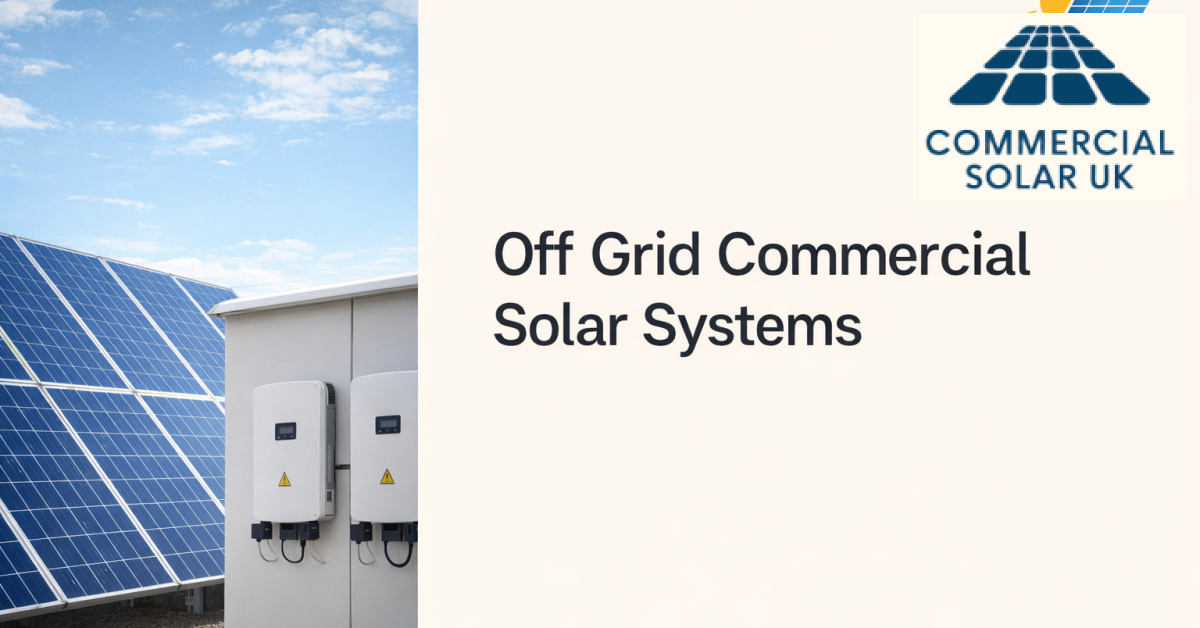
Off Grid Commercial Solar Systems
An off grid commercial solar installation is an entirely self-contained power plant for your business. It operates completely independently of the National Grid. These are not just solar arrays, they are engineered ecosystems designed for one purpose: to provide stable, reliable power where the grid is unavailable, unstable, or the cost of connection is prohibitive.
Success depends entirely on the quality of the initial design, the load profiling, and the correct specification of every component to handle the unique demands of your site year-round.
What Is An Off Grid Commercial Solar System?
An off-grid setup means every kilowatt-hour your business consumes is generated and stored on-site. There is no fallback to the public network. This is a fundamental departure from grid-tied systems, which use the grid as a giant, shared battery. All energy is produced on site and stored for use when generation is low.
System design focuses on matching generation and storage to the building’s load profile. The following sections define the core components, explain how off grid systems differ from grid-tied systems, and outline typical UK use cases.
Definition And Core Components
An off grid commercial solar system includes solar panels, battery storage, inverters, charge controllers, and often a backup generator. Solar panels generate electricity during daylight hours. Batteries store surplus energy for evening or low-light periods. Inverters convert stored DC electricity into usable AC power for commercial equipment.
The system comprises a solar PV array, a significant battery bank (often lithium-ion), high-capacity inverters to create a stable AC waveform, and charge controllers. For most UK commercial applications, a backup generator (typically diesel or LPG) is essential for resilience during the low-sunlight months of November to February.
How Off Grid Systems Differ From Grid Tied Systems
Off grid systems operate independently and do not export surplus electricity. Grid-tied systems connect to the national network and use it as backup. Off grid systems cannot export power. They require meticulous energy demand analysis because there is no external supply to cover shortfalls.
This means larger battery banks and more sophisticated control systems are not optional, they are mandatory for operational success.
Typical Use Cases In The UK
UK businesses adopt off grid systems in remote rural locations, on agricultural land, at construction compounds, and in temporary or modular commercial units. High grid connection costs also drive adoption where Distribution Network Operator upgrades are uneconomic.
We see the highest demand from agricultural operations in areas with high grid connection costs like North Scotland, construction sites needing temporary power, and rural hospitality venues. A farm in Cumbria or a seasonal wedding venue in the Cotswolds face similar challenges: an unreliable local grid or economically unviable DNO upgrade charges.
How Off Grid Commercial Solar Systems Work
Off grid systems follow a simple energy path: generation, storage, conversion, and distribution. Each stage must be sized to support peak demand and seasonal variation.
Reliable performance depends on correct integration between panels, batteries, control equipment, and backup generation. Weak design at any stage affects overall stability.
Solar Panels And Energy Generation
Solar panels convert daylight into direct current electricity. Output varies by panel orientation, tilt angle, shading, and seasonal sunlight hours. UK winter generation drops significantly compared with summer, which increases the importance of storage and backup planning.
Battery Storage And Energy Management
Battery storage holds excess electricity for later use. Energy management systems prioritise critical loads and prevent over-discharge. Commercial installations often use lithium-ion batteries due to higher efficiency and longer cycle life compared with older lead-acid systems.
Inverters, Charge Controllers, And Backup Generators
Inverters convert DC electricity into AC for business equipment. Charge controllers regulate power flow from panels to batteries, preventing damage. Many commercial systems include a diesel or LPG generator to provide emergency backup during prolonged low-generation periods.
System Monitoring And Controls
Monitoring software tracks generation, battery state of charge, and load demand in real time. Remote monitoring allows operators to identify faults quickly. Commercial users benefit from automated alerts and performance data to support maintenance planning.
Key Components Of Off Grid Commercial Solar Systems
Each component plays a defined role in delivering stable, independent power. Commercial sites require equipment designed for higher loads and longer operating hours than domestic systems.
| Component | Function | Why It Matters For Commercial Sites | Typical UK Considerations |
|---|---|---|---|
| Solar Panels | Generate DC electricity from sunlight | Determines total generation capacity | Lower winter irradiance affects sizing |
| Battery Storage | Stores excess electricity | Maintains supply outside daylight hours | Temperature control improves lifespan |
| Inverter | Converts DC to AC power | Enables compatibility with commercial equipment | Three-phase output often required |
| Charge Controller | Regulates battery charging | Protects battery health and efficiency | MPPT controllers improve yield |
| Backup Generator | Provides emergency power | Maintains operations during shortages | Fuel storage and emissions compliance |
Correct integration of these components determines overall system reliability.
Benefits Of Off Grid Solar For Commercial Properties
Off grid systems provide operational control where grid supply is limited or unstable. Businesses gain independence from network disruptions and rising electricity tariffs.
Financial outcomes depend on upfront investment, load stability, and long-term operational planning. The following benefits outline practical advantages for suitable sites.
Energy Independence And Resilience
Energy independence reduces exposure to grid outages and price volatility. On-site generation supports business continuity during regional supply failures. Critical services remain operational if storage and backup capacity are correctly sized.
Long-Term Cost Control
Upfront capital expenditure replaces ongoing electricity purchases. Predictable maintenance and replacement cycles improve budget forecasting. High grid connection charges can make off grid systems economically favourable over time.
Suitability For Remote Or Hard-To-Connect Sites
Remote agricultural buildings, estates, and industrial units often face high grid upgrade costs. Off grid systems remove the need for new substations or long cable runs. Temporary sites also benefit from relocatable solar and battery systems.
Environmental And Corporate Sustainability Impact
On-site renewable generation reduces reliance on fossil fuels. Businesses use off grid systems to support carbon reduction targets and environmental reporting requirements. Visible renewable infrastructure also supports corporate sustainability commitments.
Acknowledging the Limitations: Winter Sun & Sizing Realities
An off-grid system carries higher risk than a grid-tied one. There is no margin for error in the planning phase.
- Load Profiling is Everything: We must capture precise data on your energy consumption, hour by hour, across all seasons. An undersized system guarantees power cuts; an oversized one wastes capital.
- Physical Footprint: A commercial scale solar array requires significant unshaded roof or ground space. Battery banks need a secure, compliant enclosure with fire suppression and ventilation.
- The UK Winter Challenge: From November to February, solar generation is drastically reduced. The system must be sized to survive on battery storage and periodic generator runs during these months. Anyone promising 100% solar uptime in a UK winter is not being honest.
- Ownership Responsibility: You own the power station, which means you are responsible for its maintenance. This includes panel cleaning, inverter servicing, and managing the fuel and upkeep of the backup generator.
Off Grid Vs Grid Tied Commercial Solar Systems
Off grid and grid-tied systems serve different operational priorities. The choice depends on site location, reliability needs, and financial considerations.
| Feature | Off Grid System | Grid-Tied System | Best Suited For |
|---|---|---|---|
| Grid Connection | No connection | Connected to national grid | Urban or serviced sites |
| Battery Requirement | Essential | Optional | Remote or isolated sites |
| Backup Source | Generator required | Grid acts as backup | Businesses needing resilience |
| Export Capability | No export | Can export surplus | Sites with stable grid access |
| Complexity | Higher system design demands | Simpler configuration | Lower-risk installations |
The correct model depends on business risk tolerance and connection costs.
Costs And Return On Investment
Off grid commercial solar systems involve higher upfront costs than grid-tied alternatives due to battery storage and backup equipment. Return on investment depends on avoided grid connection costs, energy savings, and operational resilience value.
Financial planning must consider capital expenditure, replacement cycles, and maintenance obligations.
Capital Costs And System Sizing Factors
Capital cost depends on system capacity, battery size, inverter specification, and installation complexity. Larger peak loads require more panels and storage. Three-phase systems increase equipment costs compared with single-phase installations.
Battery Storage Cost Drivers
Battery capacity represents a significant portion of project cost. Lithium-ion systems command higher upfront prices but offer longer cycle life and improved efficiency. Depth of discharge settings also influence lifespan and replacement timing.
Maintenance And Replacement Cycles
Solar panels typically last 25 years or more. Inverters often require replacement within 10 to 15 years. Battery lifespan depends on usage patterns and environmental conditions.
Long-Term Financial Planning
Financial modelling should include generator fuel costs, battery replacement, and servicing. Businesses often compare lifecycle cost against grid extension or diesel-only alternatives to determine viability.
Planning Permission And Regulatory Considerations In The UK
Planning and compliance requirements vary by site type and installation scale. Early consultation with local authorities reduces delays.
Health and safety obligations apply to electrical installations, battery systems, and fuel storage where generators are used.
Permitted Development And When Permission Is Required
Certain commercial rooftop solar installations fall under permitted development rights. Ground-mounted arrays or installations in conservation areas often require formal planning permission. Local authority guidance defines thresholds.
Health And Safety Compliance
Electrical installations must comply with relevant UK standards and building regulations. Battery systems require fire risk assessments and safe installation practices. Qualified installers ensure compliance with current regulations.
Insurance And Business Continuity Considerations
Insurers may require notification of significant electrical upgrades. Backup systems support business continuity planning but must meet policy conditions. Documented maintenance records strengthen compliance.
Is An Off Grid Commercial Solar System Right For Your Business?
Off grid solar suits businesses that face high grid connection costs or require independent power supply. Careful assessment ensures the system supports operational demand year round.
Decision making should combine technical feasibility, financial modelling, and regulatory compliance. This solution is ideal for businesses where grid connection is either a financial or logistical impossibility, or for those who require a level of power security the national network cannot guarantee.
Business Types That Benefit Most
Agricultural operations, remote hospitality venues, construction sites, and estate buildings benefit most. Sites with predictable daytime demand align well with solar generation patterns.
Key Questions To Ask Before Installation
Businesses should assess peak demand, seasonal variation, available installation space, and tolerance for generator backup. Financial comparison with grid extension provides a baseline for decision-making.
Professional Site Surveys And Feasibility Studies
Professional surveys analyse load data, shading, structural integrity, and compliance requirements. Detailed feasibility studies provide system sizing recommendations and lifecycle cost projections.
We begin every project with a professional feasibility study. This involves analysing your load data, conducting a full site survey to assess shading and structural issues, and providing a transparent report on system sizing, lifecycle costs, and expected performance. This ensures you have the verifiable data needed to make a sound investment decision.
All our installations are designed and commissioned to meet the highest industry standards, ensuring the work is completed by accredited experts using proven technology. We ensure you receive the full documentation, like an MCS certificate, which is a mark of quality for your installation.
Conclusion
Off grid commercial solar systems provide independent electricity supply for businesses that cannot rely on or access the national grid. Performance depends on accurate demand assessment, sufficient battery capacity, and careful integration of control and backup systems.
For suitable sites, off grid solar offers resilience, predictable long-term costs, and reduced environmental impact, provided planning and operational responsibilities are fully understood.