Getting Started with Commercial Solar
For UK businesses, installing commercial solar is no longer a fringe decision, it’s a critical infrastructure upgrade. A properly engineered system isn’t just about carbon reporting; it’s about taking direct control over volatile energy costs and building operational resilience.
The path involves a detailed site assessment, rigorous financial modeling, securing necessary approvals from the right bodies, and a high-quality installation. Our goal is to walk you through each stage, drawing from our direct experience on sites across the UK.
What a Commercial Solar System Actually Means for Your Business
Commercial solar photovoltaic (PV) systems are engineered to generate power that is consumed directly on your premises. The primary financial driver is displacing electricity you would otherwise buy from the grid at peak rates. We design systems differently for a food processing plant in Lincolnshire with heavy daytime machinery load versus a logistics hub in the Midlands with lower, but constant, energy needs.
You can find out more about Common commercial solar myths in our dedicated guide.
A commercial system is defined not just by its size (typically over 30 kWp), but by its connection to the three-phase electrical supply common in business properties. The entire project requires formal grid approval from your local Distribution Network Operator (DNO), whether that’s Scottish and Southern Electricity Networks (SSEN) or National Grid in the Midlands.
Our financial assessments focus on payback period, Internal Rate of Return (IRR), and how tax relief under current HMRC rules impacts your bottom line.
If you want a quick reference for the jargon used in proposals and grid applications, our commercial solar key terms and definitions guide explains the most common terminology.
The businesses that see the fastest returns are those with high daytime energy consumption. We have seen the most significant impact at manufacturing sites, cold storage facilities, and large agricultural operations where daytime solar generation directly matches the hours of highest operational demand.
If you need a clearer baseline before comparing system sizes and connection types, see our guide on what commercial solar is and how it applies to UK businesses.
How a Commercial PV System Works on a UK Business Premises
Our systems are designed to convert daylight into AC electricity that seamlessly integrates with your existing electrical infrastructure. The moment solar generation begins, that power is directed to on-site loads first, from factory machinery to office lighting.
Solar Panels and Inverters
The panels, typically monocrystalline modules from brands like Trina Solar or LONGi, generate DC electricity. This power is then fed to an inverter, the brain of the system, which converts it to usable AC electricity. For larger, more complex roofs, we often specify SolarEdge or SMA inverters, which can help manage shading and optimise output at a panel level.
On-Site Consumption vs. Export to the Grid
The greatest financial benefit comes from consuming every kilowatt you generate. This avoids purchasing power from the grid at retail rates (e.g., 25-30p/kWh). Any surplus power you don’t use is exported to the grid, earning a much lower rate under a Smart Export Guarantee (SEG) tariff, which might be between 4p and 15p/kWh depending on your energy supplier.
Battery Storage Options
Businesses with significant evening or overnight power needs, such as a bakery or a facility running server banks, can use battery storage. Surplus energy generated during the day charges the battery, which then discharges during higher-cost evening tariff periods, further reducing grid imports.
Grid Connection and DNO Approval
Before any installation, an application must be made to the local DNO. Their engineers assess the local grid’s capacity to handle exported power. In some areas, particularly rural locations or older industrial estates, the grid may be constrained, requiring upgrades or limiting your maximum export capacity.
If you want a clearer view of the commercial case beyond payback, see our guide to the benefits of commercial solar for businesses.
Is Your Site Viable? Our Assessment Checklist
Technical and legal due diligence is the foundation of a successful project. We analyse roof conditions, structural load capacity, property ownership, and your specific energy usage profile to build a viable system design.
Roof Type, Structure, and Orientation
While a south-facing, unobstructed roof is ideal, we frequently design effective east-west systems. These layouts generate a broader “shoulder” of production across the working day, which can be more valuable for businesses than a sharp midday peak. Our structural engineers confirm the roof’s load-bearing capacity, which is critical for the profiled metal or single-ply membrane roofs common on UK industrial units.
Energy Usage Patterns and Half-Hourly Data
Your half-hourly energy data is the most important document for system design. It allows us to precisely match a solar generation profile against your actual consumption, ensuring we size the system for maximum self-consumption and return.
Site Ownership and Lease Considerations
For freehold properties, the decision is straightforward. For leasehold premises, landlord consent is a must. We help negotiate the terms, clarifying who owns the asset and what happens at the end of the lease term.
Planning Permission and Listed Buildings
Most commercial rooftop installations fall under permitted development rights in the UK, provided they don’t protrude more than 0.2m from the roof plane and are set back 1m from the edge. However, installations on listed buildings or in conservation areas will always require a full planning application.
The Real Costs & Financials of a Commercial Solar Project
System costs are driven by size, roof complexity, and grid connection requirements. Larger systems have a lower cost per kWp due to economies of scale. A comprehensive financial plan must account for the initial capital outlay, ongoing maintenance, tax benefits, and potential revenue.
- Upfront System Costs: This covers panels, inverters, mounting hardware, scaffolding, installation labour, design, and DNO application fees. A typical range is £700–£1,100 per kWp; a simple installation on a modern warehouse will be at the lower end, while a complex roof needing specialist access could be higher.
- Operating and Maintenance Costs: We budget around £10–£20 per kWp annually for monitoring, scheduled inspections, and periodic cleaning to ensure optimal performance.
- Tax Relief and Capital Allowances: Under current UK government rules, solar panels qualify as main rate plant and machinery, making them eligible for 100% “full expensing” capital allowances for limited companies. This allows you to deduct the full cost from your taxable profits in the first year.
You can compare related options in Commercial solar site suitability assessment for additional context.
Funding Your System: PPA, Asset Finance, or Outright Purchase
The funding route you choose dictates ownership, risk, and how savings are realised. Your decision will depend on capital availability and financial strategy.
- Outright Purchase: This offers the highest long-term returns. Your business owns the asset and retains 100% of the financial benefits from day one.
- Asset Finance and Leasing: This spreads the capital cost over a fixed term, typically 5-7 years. It reduces the initial cash outlay but adds interest charges to the overall cost.
- Power Purchase Agreements (PPAs): A third-party funder pays for the installation and owns the system on your roof. You then buy the solar-generated electricity from the funder at a pre-agreed rate, lower than your grid tariff. This offers zero capital outlay and immediate savings, but the third party owns the asset.
Calculating Your Actual Savings, Payback, and ROI
Financial performance is determined by how much grid electricity you avoid, the rate you get for exported power, and system efficiency. Our modeling uses your half-hourly data and current tariffs for accuracy.
- Energy Bill Savings: This is calculated by multiplying the kWh of solar power you consume on-site by the rate you would have paid to your utility for that power.
- Export Payments (SEG): Licensed suppliers like Octopus Energy or British Gas offer SEG tariffs for surplus power you export. These rates vary, so it’s a secondary benefit compared to on-site consumption.
- Payback Period and IRR: The payback period is the time it takes for net savings to cover the initial investment. The Internal Rate of Return (IRR) is a more sophisticated metric that calculates the average annual return over the system’s 25+ year lifespan. Key factors influencing these are future electricity price inflation, system degradation (around 0.5% per year), and your self-consumption ratio.
If you’re comparing design options for different sites, our overview of common commercial solar system types can help you understand the main configurations used on UK business premises.
Commercial Solar UK Installation Process: From Survey to Switch On
Our projects follow a structured sequence managed by a dedicated project manager to ensure minimal disruption to your operations.
- Initial Site Survey & Feasibility: We inspect your roof’s condition, the integrity of its waterproofing, your existing electrical setup, and site access. This data feeds a preliminary feasibility model estimating generation and savings.
- System Design & Performance Modelling: Our engineers use software to map the panel layout, select the appropriate inverter configuration (e.g., string or SolarEdge with optimisers), and plan cable runs. This produces a detailed performance forecast based on UK irradiance data.
- Permissions & Paperwork: We manage the DNO application and any necessary planning submissions. Full DNO approval is mandatory before the system can be energised.
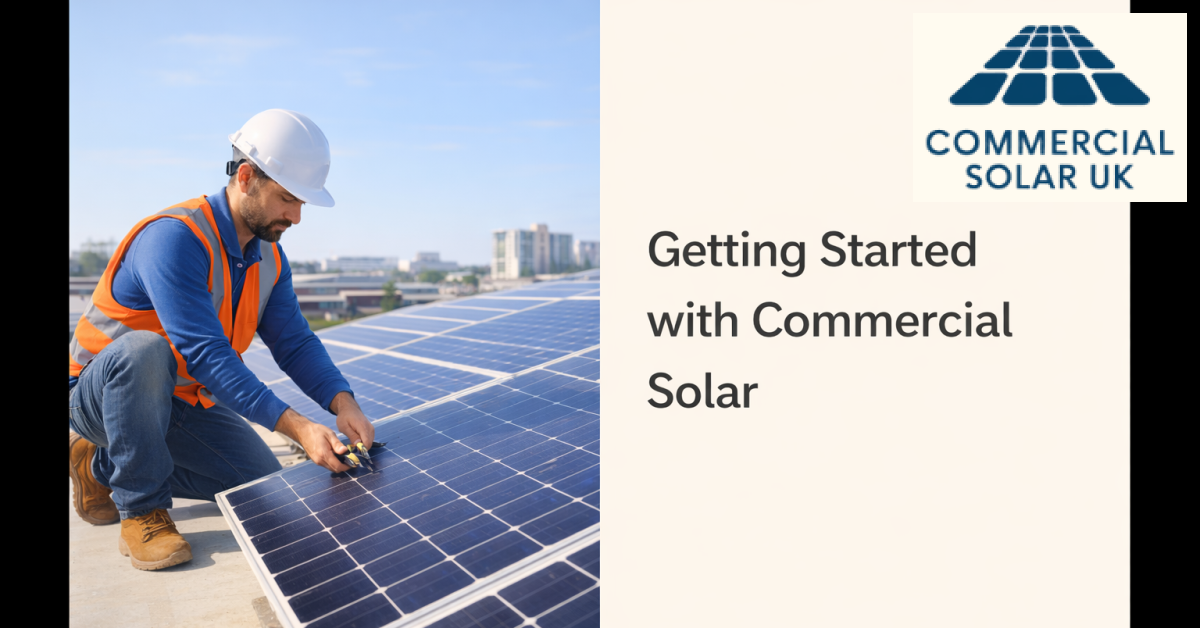
- Installation, Testing & Commissioning: Our MCS-certified team installs the mounting frame, fits the panels, and connects the inverters and cabling. We conduct rigorous electrical testing to comply with BS 7671 wiring regulations before commissioning the system.
- Ongoing Monitoring & Maintenance: We provide access to a monitoring portal to track real-time generation. Our service agreements include scheduled health checks to maintain warranties and long-term performance.
If you want a clearer sense of sequencing and typical durations, see our commercial solar project timeline overview before you start planning internal resources.
Navigating UK Compliance: MCS, DNOs, and Warranties
Adherence to UK standards is non-negotiable, protecting your investment and ensuring safety.
- MCS Certification: The Microgeneration Certification Scheme (MCS) is the UK’s quality mark for renewable installers. Choosing an MCS-accredited installer is often a requirement for insurance and proves the work meets recognised technical standards.
- Electrical and Building Regulations: All electrical work must comply with BS 7671 (The IET Wiring Regulations). We handle all necessary notifications to Local Authority Building Control.
- Equipment Warranties: Solar panels carry performance warranties, typically guaranteeing 85-90% of their original output after 25 years. Inverters have shorter warranties, usually 5-12 years, though this can often be extended.
Selecting the Right Commercial Solar Installer
An installer’s experience directly impacts your project’s performance. When evaluating proposals, look beyond the headline price.
- Experience With Similar Projects: Ask for case studies of installations on buildings similar to yours, for instance, a high-bay warehouse or a food production facility. An installer with experience in your sector will understand its unique structural and electrical challenges.
- Transparent Proposals: A credible proposal clearly states the brands of panels and inverters being used, the estimated annual generation, the degradation rate assumed, and all financial inputs used in the ROI calculation.
- Aftercare and Service Agreements: What happens after the installation is complete? A clear service agreement defines maintenance schedules, response times for fault rectification, and who is responsible for monitoring system performance.
FAQs from UK Business Owners
How long does an installation take?
The design and approval stage can take 4-12 weeks, depending on DNO responsiveness. The physical installation on a mid-sized warehouse (100-250 kWp) typically takes one to three weeks.
How much roof space do I need?
We work on a general rule of 4 to 5 square metres per kWp, depending on the panel efficiency and roof layout. A 100 kWp system would need about 400-500 m².
What happens during a power cut?
Standard grid-tied systems are required to shut down during a grid outage for safety. If you need backup power, a battery storage system specifically configured for island mode operation is required.
Are industrial units suitable for solar panels?
They are often perfect candidates. Their large, simple roof structures are cost-effective to work on, and their high daytime power demand ensures a fantastic self-consumption rate and return on investment.
Your Next Steps
Commercial solar offers a proven path to reducing electricity costs, achieving carbon reduction targets, and securing your business against energy price volatility. The key to a successful project is a thorough assessment, realistic financial modelling, and choosing an experienced installation partner.
If you’re ready to scope a project, commercial solar panels for businesses can help you compare system options, funding routes, and installation timelines for UK sites.
Before you commit to a funding route or installer, align internal priorities by involving the commercial solar stakeholders and decision makers who will sign off on budgets, compliance, and operational impact.