

Solar Panels For Industrial Estates
Industrial estates across the United Kingdom face a dual challenge: crippling energy price volatility and significant delays for new or upgraded grid connections. For manufacturing, logistics, and warehousing, these issues directly threaten operational budgets and expansion plans. On-site solar generation offers a direct path to energy independence, creating budget certainty and insulating operations from unpredictable wholesale energy markets and grid capacity constraints. Our focus is on engineering robust photovoltaic (PV) systems that align with the specific operational demands and structural realities of UK industrial facilities.
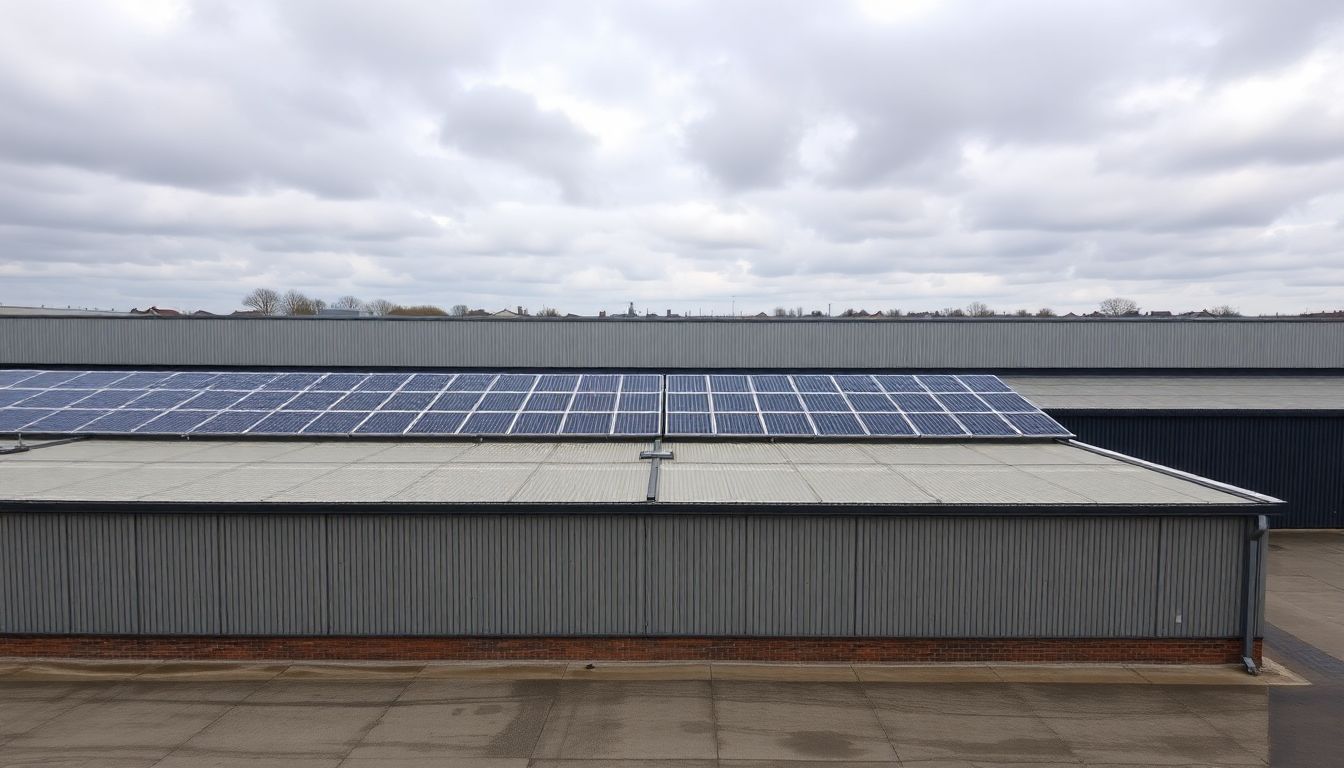
The Rise of Industrial Solar Power
The number of UK business premises for transport and storage has nearly doubled in the last decade, concentrating heavily in the Midlands’ “Golden Logistics Triangle”. This rapid growth, combined with the electrification of vehicle fleets and industrial processes, has placed unprecedented strain on the electrical grid. Businesses applying for new or upgraded connections now face potential delays of 2 to 12 years, with over 700 GW of projects currently in the queue. This “gridlock” freezes expansion and leaves companies exposed to volatile electricity tariffs, which have seen sharp increases for British manufacturers.
On-site solar generation circumvents this bottleneck for a significant portion of your daytime energy load. By producing power directly where it is consumed, you reduce reliance on an overloaded grid and gain control over a primary operational cost.
Financial and Operational Resilience with On-Site Generation
Investing in a commercial solar installation provides a measurable return by directly offsetting grid electricity costs. The financial model is supported by current UK government incentives designed to accelerate commercial decarbonisation. Businesses can deduct 100% of the system’s cost from taxable profits in the first year through Capital Allowances like the Annual Investment Allowance (AIA). Additionally, new rooftop solar installations are exempt from business rates for 10 years. Any surplus power not used on-site can be sold back to the grid through the Smart Export Guarantee (SEG) scheme, creating a new revenue stream.
Our clients’ results demonstrate the financial impact.
Case Study: Leeways Packaging Services
This facility now generates 2.4 million kWh of its own power annually. This on-site production covers 20% of their yearly energy requirements and resulted in a 70% cost saving against their previous grid-supplied electricity tariffs.
Case Study: Walsh Mushrooms
The solar array installed at Walsh Mushrooms generated a £49,376 saving in its first year of operation. The system also prevents 92 tonnes of CO2 from entering the atmosphere annually, supporting the company’s sustainability reporting.
Case Study: Stewart Golf
This installation cut the company’s reliance on grid power for its daily operations. The result was a 70% reduction in their electricity expenditure.
Engineering Solar for Your Estate’s Infrastructure
A successful industrial solar project requires more than just panels. It demands an engineering approach that respects the building’s structural integrity and integrates seamlessly with the site’s energy profile.
Adapting to Existing Roof Structures
Most UK industrial estates feature large, flat roofs or pitched roofs with profiled metal sheets. Our structural assessment first verifies the load-bearing capacity of your building’s frame. We then design mounting systems appropriate for the roof type, whether it’s a single-ply membrane common on large distribution centers or the coated box profile steel sheets found on many trade units. Our designs ensure panel security and roof integrity for a minimum of 25 years.
Integrating with Site Operations via IoT Monitoring
We integrate smart IoT monitoring systems that provide granular, real-time data on energy production and consumption. This allows facility managers to track system performance via mobile applications and identify opportunities for load-shifting to maximize the use of self-generated power. These systems provide early fault detection, enabling rapid maintenance and ensuring minimal downtime. The data also strengthens ESG reporting for frameworks like the Building Research Establishment Environmental Assessment Method (BREEAM), which is increasingly required for modern industrial buildings.
Conclusion: Securing Your Facility’s Energy Future
For industrial estates in the UK, on-site solar is a strategic investment in operational resilience. It directly addresses the business risks of grid unreliability and volatile energy costs. By generating predictable, low-cost electricity on-site, companies can protect their budgets, meet their sustainability goals, and power their long-term growth. Commercial Solar UK develops custom-engineered systems that deliver these outcomes, based on the specific needs of your facility.
Contact our team for a detailed site assessment and financial projection.
Frequently Asked Questions
Why Should UK Businesses Install Solar Panels on Commercial Buildings?
The primary drivers are financial and operational. Solar provides a hedge against volatile wholesale energy prices, reduces operational costs, and offers tax benefits through capital allowances. It also mitigates risks from grid connection delays that can halt business expansion.
How Much Do Solar Panels Cost for Large Commercial Estates in The UK?
The cost is dependent on the system size (kWp), the type of panels and inverters specified, and the existing electrical infrastructure. We provide detailed quotes after a site survey, which include financing options like capital investment or a Power Purchase Agreement (PPA) to eliminate upfront costs.
Is “Free Solar” a Viable Option for Industrial Estates?
The original “free solar” models were tied to the now-defunct Feed-in Tariff. Today, the modern equivalent is a Power Purchase Agreement (PPA). Under a PPA, we install the system at no capital cost to you, and you agree to buy the generated electricity from us at a fixed, discounted rate, which is lower than your current grid tariff.
Do Photovoltaic Systems Protect Industrial Sites During a Power Cut?
A standard grid-tied PV system is designed to shut down during a power cut for safety. To maintain operations during a grid outage, the solar system must be paired with an appropriately sized battery energy storage system (BESS). We can model and specify hybrid systems that provide this level of resilience.
Will Installing Business Solar Help My Company’s Climate Change Goals?
Yes. On-site solar generation directly reduces your facility’s Scope 2 carbon emissions by replacing grid electricity, which still has a carbon-intensive component. The generation data is verifiable and can be used for corporate ESG and BREEAM reporting.
Does Adding Photovoltaics Increase an Industrial Property’s Asset Value?
Evidence suggests it does. A building with its own power generation is more attractive to potential tenants and buyers due to lower, more predictable operating costs and improved sustainability credentials. A high-quality solar installation can improve a building’s Energy Performance Certificate (EPC) and BREEAM rating.